TLDR
If you are researching PPF used car Utah options, do not reject the idea merely because the vehicle has miles on it. PPF can be worthwhile when the paint is stable, the car still has meaningful value to you, and future driving will expose vulnerable panels to more chips and wear. It becomes a weaker purchase when the paint needs substantial repair, the vehicle will be sold soon, or the proposed coverage protects panels that are already heavily deteriorated.
Start with an inspection, disclose any repaint or body-repair history, and compare protection against future exposure—not damage that has already happened. For many used Utah daily drivers, targeted, partial-front, full-front, or high-impact coverage is easier to justify than full-body film.
Is PPF worth it on a used car in Utah?
It can be. The useful question is not “How old is the car?” but “What paint is still worth preserving, and what will happen to it during the rest of my ownership?” A well-kept six-year-old commuter that will spend another five years on I-15 may be a stronger candidate than a nearly new vehicle that will be sold within a year and driven very little.
PPF is forward-looking protection. It is intended to help protect covered paint from rock chips, road debris, and daily wear; it does not restore missing paint or erase existing defects. Ceramic coating and vinyl wrap also serve different purposes: coating primarily supports gloss, water behavior, and easier cleaning, while vinyl wrap is generally used for a color or graphics change rather than as a direct substitute for impact-focused PPF.
Use this seven-factor decision framework
| Factor | Favors PPF | Reason to pause |
|---|---|---|
| Paint condition | Stable paint with limited chips or defects | Peeling clear coat, corrosion, unstable repairs, or broad deterioration |
| Vehicle value | The vehicle is valuable financially, emotionally, or difficult to replace | The protection cost would displace more important repairs or maintenance |
| Repair history | Known repairs that an installer can inspect and accept | Unknown repaint history or concern about paint adhesion and later removal |
| Ownership horizon | You expect to keep the vehicle for several years | You plan to sell or trade it soon |
| Annual mileage | Frequent freeway, canyon, construction-zone, or winter driving | Low mileage with limited exposure |
| Vulnerable panels | The bumper, hood, mirrors, rockers, or wheel-impact zones remain in good condition | The proposed panels are already extensively damaged |
| Buyer priorities | You care about preserving the current finish and reducing future chips | You expect PPF to restore paint or guarantee a financial return |
No single row decides the purchase. A high-mileage car can still qualify if its paint is sound and it has years of hard use ahead. Conversely, low mileage does not automatically justify film if the owner is indifferent to cosmetic wear or needs to address mechanical and paint problems first.
Inspect the paint before choosing coverage
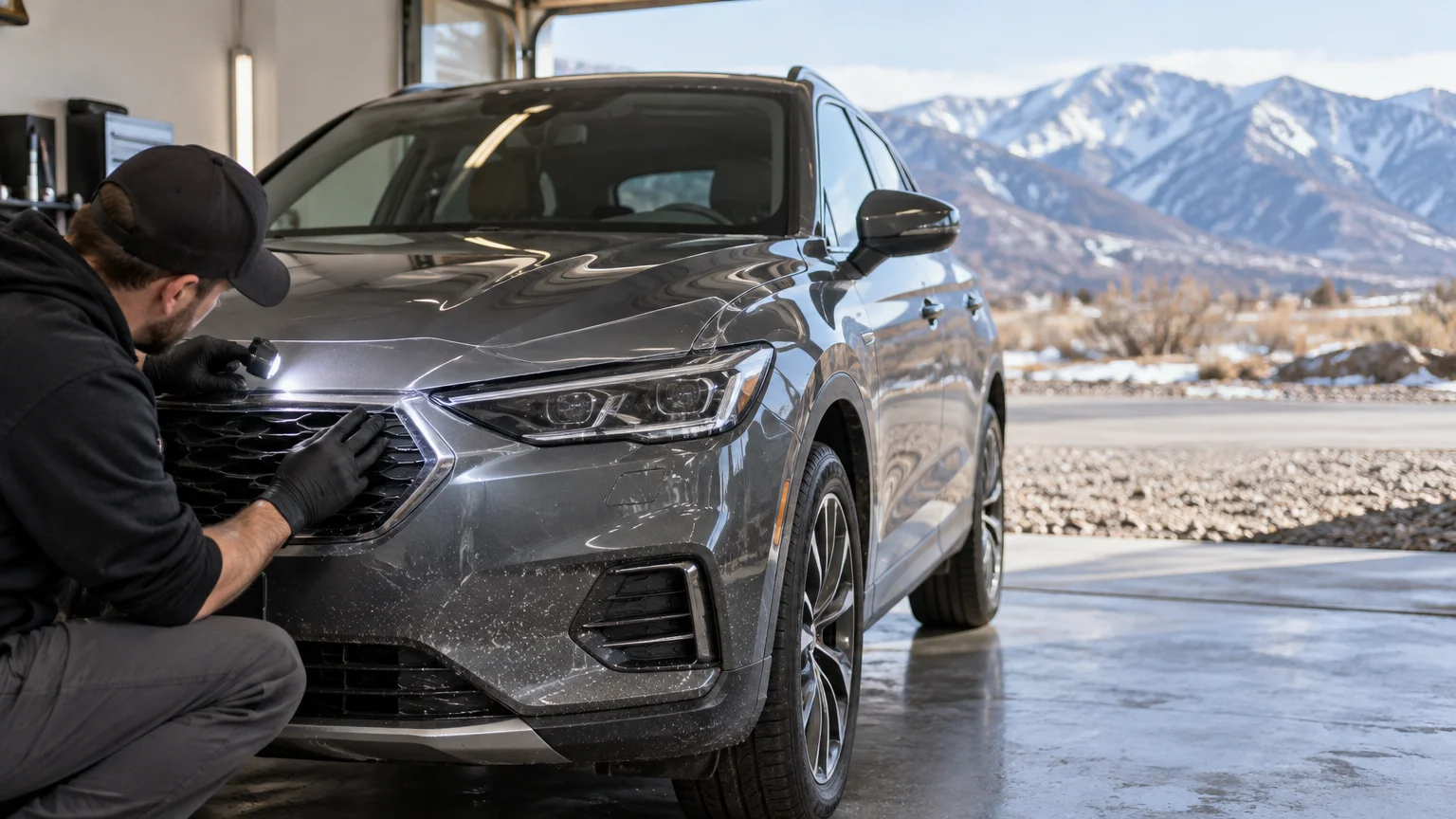
Wash the vehicle and inspect it in strong, even light. Look closely at the bumper, hood, fender leading edges, mirror caps, rocker panels, lower doors, areas ahead of the rear wheels, and luggage-loading surfaces. Note chips, scratches, touch-up paint, clear-coat failure, corrosion, overspray, mismatched texture, and panel-to-panel color differences.
Clear film should not be treated as a way to conceal defects. Some flaws may remain visible through it, and unstable paint or uncertain repairs can complicate installation and eventual removal. Ask the installer which defects can remain, which should be corrected first, and whether any panel should be excluded. Do not approve polishing, touch-up work, paint correction, or body repair until you understand its purpose and separate cost.
Repair history deserves special attention. Utah DMV advises private-party buyers to ask whether a vehicle has been repainted or received body repairs and to obtain an inspection before buying. Its private-party vehicle buying guidance is useful even after purchase because repair history affects what you should disclose before a film consultation.
There is no responsible universal promise that film can be installed and later removed safely from every repainted bumper, hood, or fender. Tell the installer what was repaired, when it was painted if known, and whether there are chips, touch-up areas, or adhesion concerns. Request a panel-specific assessment rather than a blanket yes or no.
Match coverage to the damage that has not happened yet
A used car rarely needs an all-or-nothing decision. Protect the panels facing the most future exposure while considering how much good paint remains.
- Targeted coverage: Consider an isolated bumper, luggage ledge, rocker area, or another specific surface when one zone takes most of the abuse.
- Partial front: A practical entry point for the bumper and a portion of the hood and fenders, depending on the installer’s coverage map. It can leave visible termination lines, so inspect examples and confirm exactly where the film ends.
- Full front: Often includes the bumper, full hood, full front fenders, mirrors, and sometimes headlights, but package definitions vary. Confirm every panel in writing.
- High impact: Adds areas such as rocker panels, lower doors, or rear wheel-impact zones to front-end protection. It can make sense for wider vehicles, gravel access, and frequent mountain recreation.
- Full body: Broadly protects painted surfaces, but it is generally easier to justify on a high-value vehicle, a specialty or matte finish, or a used vehicle with unusually clean paint that the owner plans to retain.
If the budget is limited, begin by comparing partial-front coverage with full-front PPF. If the vehicle has exposed rocker panels, wide tires, or regular gravel-road use, compare those options with a high-impact package. Two packages with the same name are not equivalent until their panel maps match.
How Utah driving changes the calculation
Future exposure matters because Utah use can combine freeway debris, construction, canyon travel, gravel access, and winter road treatment. A garage-kept weekend car and a daily commuter may therefore deserve different coverage even when they are the same year and model.
UDOT says its winter operations can involve salt brine, regular and high-performance salts, grit, volcanic cinders, and potassium acetate in some locations. That does not mean PPF prevents every form of winter damage. It does mean winter commuters should consider front-end and lower-body exposure and follow appropriate washing and film-care guidance. Drivers who want operational details can consult UDOT’s snow-removal information.
For a typical used Utah commuter, start with the bumper, hood, fenders, and mirrors. Add rockers, lower doors, and rear wheel-impact areas when the vehicle’s shape, tires, or routes direct debris toward them. The guide to PPF priorities for Utah winter driving provides a deeper panel-by-panel starting point.
Do not treat PPF as a guaranteed resale investment
Film may help preserve the condition of covered paint, but the supplied evidence does not establish that it will increase resale value or recover its installation cost. Resale depends on the entire vehicle, including mileage, mechanical condition, accident and repair history, interior condition, market demand, and documentation.
A better value test is personal and practical: divide the proposed project by the years you expect to keep the vehicle, then ask whether preserving those panels is worth that annualized cost to you. This is a budgeting framework, not a forecast of resale return. Also compare the quote with deferred maintenance, tire, glass, corrosion, or paint-repair needs that may deserve priority.
How to compare used-car PPF quotes
Preparation can make used-car quotes look unusually different. One provider may quote film over the vehicle’s current condition, while another includes decontamination, polishing, paint correction, touch-up coordination, or removal of old film. Normalize the job before comparing price.
- List every covered panel and whether each panel receives full or partial coverage.
- Identify the film manufacturer and product line, including clear, matte, or other finish.
- Ask how chips, scratches, touch-up paint, overspray, and repainted panels will be handled.
- Separate required preparation from optional cosmetic correction.
- Clarify edge treatment, seams, pattern choices, and visible termination lines where relevant.
- Request the warranty terms, exclusions, claim process, and required installation records.
- Ask whether headlights, rocker panels, door edges, luggage areas, or coating are included or separate.
- Confirm the total price for the same coverage and preparation scope.
Read the warranty for the actual film being quoted rather than assuming all brands use the same terms. For example, XPEL states that its applicable warranty covers film rather than damage to the paint beneath it and requires proof of installation from an authorized installer for claims. Those are XPEL-specific terms, not universal PPF rules.
A quick decision guide
- Good candidate: Stable, presentable paint; several years of planned ownership; meaningful freeway, canyon, winter, or gravel exposure; and clear panel priorities.
- Conditional candidate: Some chips or repaired panels, but substantial good paint remains. Obtain an in-person inspection and price preparation separately.
- Pause before installing: Peeling clear coat, corrosion, uncertain paint stability, fresh or undocumented repaint work, or defects that require body-shop evaluation.
- Lower priority: Short ownership horizon, very low exposure, extensive existing deterioration, or more urgent mechanical and safety expenses.
Common questions about PPF on a used vehicle
How old is too old for PPF?
There is no useful age cutoff. Paint stability, existing condition, future mileage, ownership horizon, and budget matter more than the model year.
Can PPF go over rock chips or touch-up paint?
Do not assume every chip or touch-up area can simply be covered. Film will not replace missing paint, and existing defects may remain visible. Have the installer inspect the surface and explain whether repair, curing time, correction, or exclusion is appropriate.
Should I choose ceramic coating instead?
Choose based on the problem. PPF is the impact-focused option for vulnerable paint. Ceramic coating is primarily relevant to gloss, water behavior, and easier cleaning. Some owners use both, but a coating should not be presented as equivalent protection against rock impacts.
Make the decision from the panels outward
For a used car in Utah, first inspect the paint and document repairs. Then estimate how long you will keep the vehicle, where it will be driven, and which panels will take the hits. Request quotes for the same coverage map and the same preparation scope. If the paint is stable and the car has years of exposed driving ahead, focused PPF can be sensible. If the surface needs major work or ownership will be brief, pause and direct the budget where it has greater value.
1 thought on “Is PPF Worth It on a Used Car in Utah? A Better Way to Decide”