TLDR: Yes, you can generally add more PPF later. The cleanest approach is to expand across complete panels, document the film used during the first installation, and decide on your eventual coverage map before work begins. Moving from a full front to added rocker panels and rear-wheel impact areas is usually more straightforward than converting partial hood or fender coverage into full-panel coverage. Existing film age, paint condition, finish, prior repairs, and product availability can all affect the plan.
If you are asking “can you add more PPF later,” the practical answer is that staged coverage can work well when each phase protects a logical group of panels. Start with the surfaces taking the most road exposure, then add lower-body or full-body coverage if your driving and ownership plans justify it. Do not assume, however, that newly installed film will look identical to older film or that every upgrade can be completed without removing part of the original installation.
Can you add more PPF later without starting over?
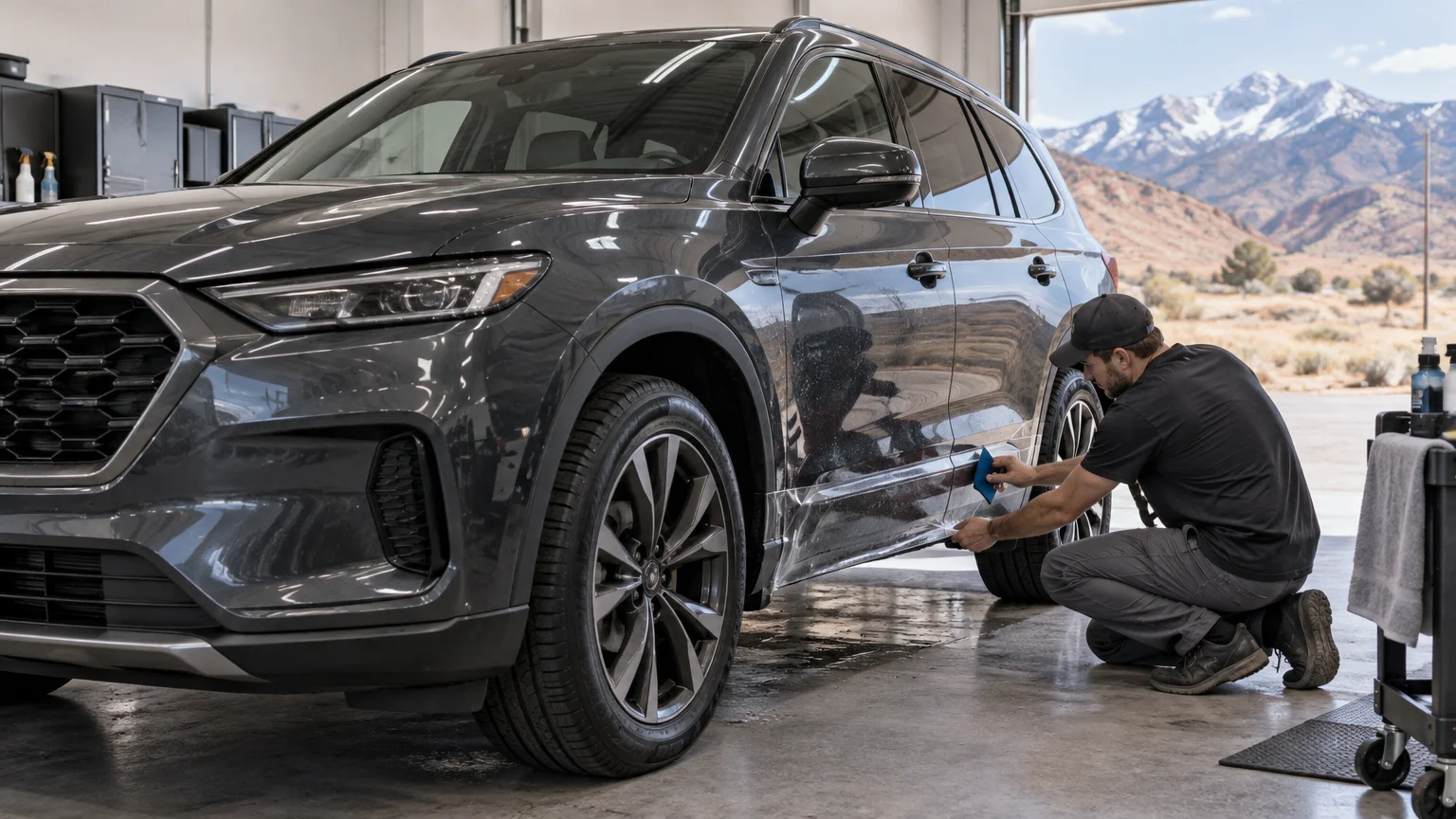
In many cases, yes. Paint protection film is installed on defined panels or portions of panels, which allows an installer to add coverage elsewhere without redoing the entire vehicle. An owner might install front-end protection first, add rocker panels before a season of ski or trailhead trips, and later protect rear-wheel impact areas or the remaining painted surfaces.
Utah PPF presents partial-front, full-front, high-impact, and full-body protection as distinct coverage levels. That creates a useful framework for planning stages, but the package name is less important than the actual panel list. Two packages with similar names may not create the same starting point for a future expansion.
Expansion is simplest when the new phase begins and ends at natural panel boundaries. Adding film to an uncovered door, rocker panel, quarter panel, or rear impact area generally avoids creating another line across the middle of a painted surface. By contrast, changing a partial hood installation into full-hood coverage may require the installer to assess whether the existing partial piece should be removed and the whole panel re-filmed.
A practical staged PPF coverage plan
| Stage | Typical coverage | Best fit | Planning issue |
|---|---|---|---|
| Focused front-end start | Front bumper plus partial hood and partial front fenders, depending on the package | Drivers prioritizing immediate chip-prone areas with limited initial scope | Partial-panel film lines may remain visible and can complicate a later full-panel upgrade |
| Full-front foundation | Front bumper, full hood, full front fenders and mirrors; headlights may be included in some packages | Freeway commuters, daily drivers and owners who want cleaner front-panel transitions | Confirm the exact included panels and whether every piece ends at a panel boundary |
| High-impact expansion | Rockers, lower doors, rear-wheel impact zones and other vehicle-specific areas | Trucks, SUVs and vehicles used on canyon, mountain, gravel or winter routes | Use tire position, body shape and actual driving exposure to select the added panels |
| Broader or full-body expansion | Remaining painted doors, quarter panels, roof areas and other exterior painted surfaces as applicable | Long-term owners seeking wider coverage or more consistent protected surfaces | Older film and new film may not match perfectly, so the installer should assess appearance and product availability |
Stage 1: Protect the front end first
For a Utah daily driver, the front end usually deserves the first look because it faces freeway debris directly. A full-front PPF package is often the most adaptable foundation when later expansion is likely. Utah PPF describes full-front coverage as including the front bumper, full hood, full front fenders and mirrors, with headlights sometimes included.
A partial-front package can still be a reasonable focused starting point, but it commonly ends partway across the hood or fenders. Those boundaries can leave visible film lines. Full-panel coverage protects the complete front panels and usually creates cleaner transitions.
If you expect to want a full front eventually, ask for both partial-front and full-front quotes before choosing. Compare the extra initial cost with the possible removal, surface preparation and replacement work involved in upgrading partial pieces later. The later route is not automatically cheaper or more expensive; the answer depends on the original layout, film condition and installer’s proposed method.
Stage 2: Add the vehicle’s high-impact zones
The next useful phase is not necessarily every remaining panel. It is often the areas exposed by the vehicle’s geometry and use: rocker panels, lower doors, rear-wheel impact areas, loading edges or other surfaces behind wide tires. Utah PPF positions high-impact PPF coverage between full-front and full-body protection, with attention to rockers, lower doors and rear impact zones for vehicles encountering mountain roads, gravel, snow, slush or cargo-heavy use.
A crossover used mainly for city errands may not need the same second stage as a wide-tire performance car or a truck traveling to gravel trailheads. Look at where grime accumulates and where the tires throw debris. That tells you more than the vehicle badge alone.
Utah winter maintenance also changes the exposure pattern. The UDOT winter road-maintenance overview says materials can include salt brine, salt, high-performance salts, de-slicking grit, volcanic cinders and potassium acetate in some locations. That context supports looking beyond the nose of the vehicle to lower-body areas, but PPF should still be treated as a sacrificial protective layer rather than a guarantee against every form of winter damage.
Stage 3: Decide whether full-body expansion is worthwhile
A later move to full-body PPF coverage may make sense for a specialty finish, a vehicle kept for many years, or an owner who wants fewer exposed painted surfaces. It is a broader commitment than adding targeted impact zones, so ask what problem the extra coverage is solving.
Full-body expansion may be attractive after the owner’s use changes—for example, a weekend vehicle becomes a high-mileage commuter. The installer should first compare the existing film with the proposed new material and inspect all uncovered paint. If appearance consistency is a high priority, the condition difference between protected and exposed panels deserves particular attention.
Will newly added PPF match the older film?
It may be close, but a perfect match should not be promised. Film appearance can change with exposure, storage, driving conditions and maintenance. XPEL states that one or two film-covered panels can be replaced, while noting that replacement material may have a slightly different hue from the film already on the vehicle.
Matching involves more than finding a brand name. The installer may need to identify the product line, gloss level, texture and age of the existing film. Matte, satin, color and other specialty finishes make product identification especially important because a small difference may be more noticeable across adjacent panels. A discontinued or unidentified product can further limit matching options.
Complete-panel boundaries help manage this issue. A small difference between two films may be less distracting when the transition follows a hood-to-fender or door-to-quarter-panel gap. It is generally harder to hide a change when old and new material meet across the middle of one panel.
Can damaged PPF be replaced panel by panel?
Panel-by-panel replacement is possible in some cases; it does not automatically require redoing the entire vehicle. The manufacturer guidance above specifically recognizes replacement of one or two covered panels, subject to the possibility of a hue difference.
The affected film still needs an inspection. An installer should determine whether the issue is limited to the sacrificial film, whether adjacent pieces or edges are affected, and what condition the paint is in underneath. If impact damage reached the paint, replacing the film alone will not repair the underlying finish.
Existing chips, scratches, stains, paint defects and previous paintwork can remain visible under clear PPF. These conditions should be identified before new film is installed. The same principle applies during an expansion: new coverage preserves the condition beneath it; it does not make existing defects disappear.
Plan the final coverage map before the first installation
You do not need to purchase every stage at once, but it helps to show the installer where you may want to end up. Ask for a panel-by-panel map of the initial work and the proposed future stages. This prevents vague package labels from hiding important differences.
For example, an owner planning full-front and lower-body protection should ask whether the initial hood and fender pieces will already cover complete panels. The owner should also identify any rocker, lower-door or rear-quarter boundaries that could affect future seams. If two quotes use different coverage maps, they are not the same job yet.
Keep a record containing:
- Film manufacturer and exact product line, if known
- Clear, gloss, matte, satin, color or other finish
- Installation date and installer information
- A written panel list and photos showing film boundaries
- Warranty and registration records, if applicable
- Known paintwork, touch-ups, chips or repaired panels
- Care history and any previous film replacement
Care between stages also matters. Utah PPF advises rinsing winter residue regularly, removing contaminants promptly and avoiding direct high-pressure spray at film edges. These steps do not guarantee an eventual visual match, but they can help preserve the installed material while you decide whether to expand.
What to send when requesting an expansion quote
A useful quote requires more than the vehicle’s year and model. The installer needs enough information to assess the existing installation and compare it with your desired final map. Utah PPF’s contact process requests vehicle information, finish, current condition, desired coverage, photos and timing.
Prepare the following before requesting an estimate:
- Year, make, model and trim
- Current PPF coverage listed panel by panel
- Film brand and product line, if available
- Installation date and whether any pieces have been replaced
- Clear photos of the vehicle, film edges and damaged areas
- Paint finish and any prior repainting, touch-up or body repair
- Normal driving exposure, such as I-15 commuting, canyon routes or gravel access roads
- The eventual coverage goal, not only the panels you want added now
- Any appearance concerns about seams, gloss, texture or color matching
Ask the installer to explain whether the quote adds film only to uncovered panels, removes and replaces existing pieces, or combines both approaches. Also request the exact film product, edge treatment, preparation assumptions and covered panels in writing. Those details let you compare the real scope rather than choosing by package name alone.
The best next step
Staged PPF works best when the first phase creates a clean foundation for the last one. For most Utah drivers planning to expand later, start by comparing full-front coverage with a focused partial front, then map the rockers, lower doors and rear-wheel impact areas that match the vehicle’s use. Choose partial-panel coverage only after understanding what an eventual full-panel upgrade could require.
Before adding anything, have the existing film, paint and prior repairs inspected. Bring the original product records if you have them, define your final coverage goal, and request a panel-by-panel proposal. That approach gives the installer a better chance to manage transitions and gives you a realistic expectation of how new film may look next to older material.
References
- Partial Front PPF Utah – Utah PPF
- Full Front PPF Utah – Utah PPF
- High-Impact PPF Utah – Utah PPF
- Full Body PPF Utah – Utah PPF
- Snow Removal | UDOT
- PPF For Utah Winter Driving: What Should You Protect First? – Utah PPF
- Frequently Asked Questions (FAQs) – XPEL Support
- How to Care for Paint Protection Film in Utah – Utah PPF
- Contact Us – Utah PPF