Paint protection film can help with the surface damage that sometimes accompanies a door ding, hail strike, or parking-lot scrape. It should not be treated as dent, hail, or collision protection. The useful dividing line is whether the incident marked the film’s surface or applied enough force to deform the panel, cut through the film, or damage the paint beneath it.
Minor swirls, rub marks, and shallow scratches may diminish on self-healing film when appropriate heat is applied. A low spot, sharp crease, puncture, or deep gouge is different: self-healing technology cannot reshape metal or restore film that has been cut through. 3M describes its film as protection against scratches, stone chips, stains, and related surface hazards, while XPEL says deeper scratches that penetrate the film may require professional repair or replacement. 3M’s Paint Protection Film documentation
What PPF can do in each situation
| Incident | What PPF may help with | What it should not be expected to prevent | What to inspect afterward |
|---|---|---|---|
| Door ding | A light scuff, rub mark, or shallow scratch on the film | A dent, crease, cracked paint, or panel deformation from the impact | View the panel from an angle. Check for a low spot or crease, then inspect the film for a remaining mark, cut, puncture, whitening, or lifted edge. |
| Hail | Some light surface marking associated with an impact | Hail dents, severe impacts, cracked paint, or punctured film | Inspect the hood, roof, decklid, and upper doors in side lighting. Look for dents, cracked paint, tears, punctures, impact marks, and damaged edges. |
| Parking-lot scrape | Minor swirls, transfer, light rub marks, and shallow surface scratches | A deep gouge, split film, exposed paint, chipped paint, or a deformed panel | Check for splits, gouges, discoloration, missing film, lifted edges, and exposed paint. Confirm whether the mark is on the film or extends through it. |
Door dings: separate the scuff from the dent
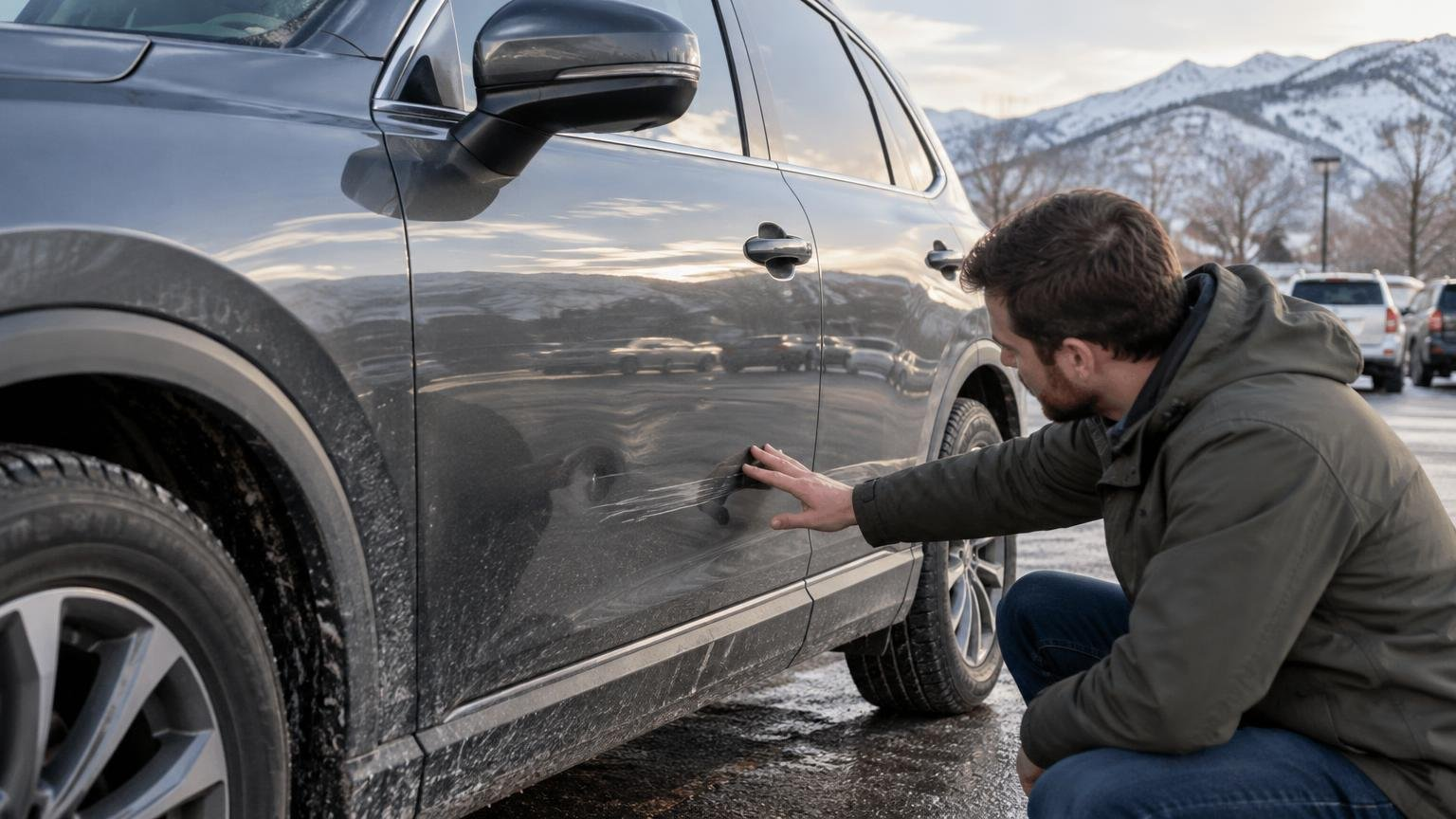
A neighboring door can leave more than one kind of damage. Its edge may rub the PPF and leave a superficial mark, but the impact can also push the vehicle’s sheet metal inward. The film may help preserve the finish at the contact point without preventing the dent itself.
Start by viewing the area from several angles under reflected light. If the reflection bends around a low spot or crease, the panel has been deformed. Self-healing film will not correct that shape. If the panel remains straight and only a faint surface line is visible, the mark may fall within the film’s self-healing capability. Our guide to self-healing PPF and light scratches explains where that capability ends.
Paintless dent repair may be suitable for some door dings, but the decision depends on factors including the paint condition, dent size and shape, location, panel access, and whether the finish has cracked, according to I-CAR’s collision-repair guidance. A qualified repair professional should assess the dent rather than assuming the presence of PPF makes it suitable for a particular repair method.
Hail: PPF is not a substitute for dent protection
Do not buy PPF with the expectation that it will prevent hail dents. Hail can apply enough concentrated force to deform the hood, roof, decklid, or upper door panels. XPEL’s limited warranty also excludes physical damage that includes hail, collision, and accidental damage; that warranty language concerns the film warranty and does not determine vehicle-insurance coverage.
After a hailstorm, inspect clean, dry panels under strong side lighting rather than looking only for obvious tears. A film-covered panel can still be dented while the film appears mostly intact. Check for rippled reflections, paint cracks, punctures, torn film, impact marks, and disturbed edges. If dents are present, let a repair professional determine whether paintless dent repair is appropriate before the film is removed or replaced.
Parking-lot scrapes: depth matters more than length
A long mark can be superficial, while a short scrape can cut through the film and paint. Light transfer, swirls, and shallow scratches may remain within the self-healing topcoat. A gouge that splits or removes film has exceeded that protective layer, and the paint beneath may also be exposed or chipped.
Avoid judging the damage by rubbing aggressively at it. First inspect for lifted edges, splits, missing material, whitening, discoloration, and exposed paint. Deep cuts, tears, impact damage, persistent bubbles, and lifted edges deserve installer inspection rather than household adhesive or an improvised repair.
The film may be replaceable even when the impact was not harmless
Damage to one covered panel does not automatically require replacing all the PPF on the vehicle. Film can sometimes be removed and replaced panel by panel after the underlying paint and adjacent material are inspected. A perfect visual match between fresh film and aged film should not be assumed, so condition and appearance belong in the repair decision. See the guide to adding or replacing PPF by panel for the practical tradeoffs.
For any of these incidents, inspect three separate layers: the film surface, the paint beneath it, and the shape of the panel. A mark confined to the film may heal or call for film replacement. A breached section may require paint repair before new film is installed. A dent or crease is body damage, even when the PPF did its job by reducing surface abrasion.
Set the expectation before choosing coverage
PPF is most useful as a sacrificial layer against chips, contact wear, and light surface abrasion. Door edges and handle cups are examples of targeted areas where film can address repeated contact wear. Broader coverage can put more painted surfaces behind that sacrificial layer, but it still does not turn those panels into impact-resistant body armor.
For a Utah driver dealing with crowded parking lots, trailhead parking, or outdoor exposure, choose coverage according to where contact and debris are likely. Then treat any visible dent, deep scrape, puncture, or cracked finish as a repair question—not a self-healing-film question. That distinction keeps expectations realistic and makes the post-damage inspection much more useful.
Frequently Asked Questions
Will PPF prevent a door ding?
PPF may reduce a light scuff or shallow scratch at the contact point, but it cannot stop enough force from denting or creasing the panel. Treat the surface mark and panel deformation as separate damage.
Does PPF protect a vehicle from hail dents?
Do not expect PPF to prevent hail dents. The film may remain intact even when the hood, roof, decklid, or upper doors have been deformed by an impact.
Can self-healing PPF repair a parking-lot scrape?
Minor swirls, rub marks, and shallow scratches may diminish with appropriate heat. A deep gouge that penetrates or removes the film requires professional inspection and may call for repair or replacement.
How can I tell whether a scrape reached the paint?
Inspect the area for split or missing film, exposed paint, chipped paint, lifted edges, whitening, and discoloration. Confirm whether the mark sits on the film or continues through it.
What should I inspect after a door ding?
View the panel from several angles under reflected light. Look for a low spot or crease, then check the film for a persistent mark, cut, puncture, whitening, or lifted edge.
How should I inspect PPF after a hailstorm?
Examine clean, dry panels under strong side lighting. Check for rippled reflections, dents, cracked paint, punctures, tears, impact marks, and disturbed film edges.
When should damaged PPF go to an installer?
Arrange an inspection for deep cuts, tears, punctures, impact damage, persistent bubbles, or lifted edges. Avoid household adhesives and improvised film repairs.
Can damaged PPF be replaced on only one panel?
Sometimes. The installer should first inspect the underlying paint and adjacent film. Fresh replacement film may not perfectly match film that has aged on neighboring panels.
References
- 3M™ Paint Protection Film
- Frequently Asked Questions (FAQs) – XPEL Support
- Self-study Narrations Module 3 – Analyzing Damage From Natural Causes
- XPEL Warranty Information – XPEL Support
- How to Care for Paint Protection Film in Utah – Utah PPF
- Can You Add More PPF Later? How to Build Coverage in Stages – Utah PPF
- Auto Films – Official 3M Support