For most Utah drivers, the choice between paint protection film and ceramic coating starts with one question: are you more concerned about physical road damage or ongoing cleaning and surface behavior? PPF is the stronger choice for vulnerable panels exposed to rocks, gravel, and road debris. Ceramic coating is primarily a surface treatment that adds hydrophobic behavior and can make routine appearance care more manageable. It does not provide the same rock-chip protection as PPF.
Some owners benefit from both: film on impact-prone panels and a compatible coating over the film and exposed paint. Others need only one, and a driver who accepts normal paint wear may reasonably choose neither. The right answer depends less on the vehicle badge than on where it travels, which panels take the hits, how often it gets washed, and how long the owner plans to keep it.
PPF and ceramic coating solve different problems
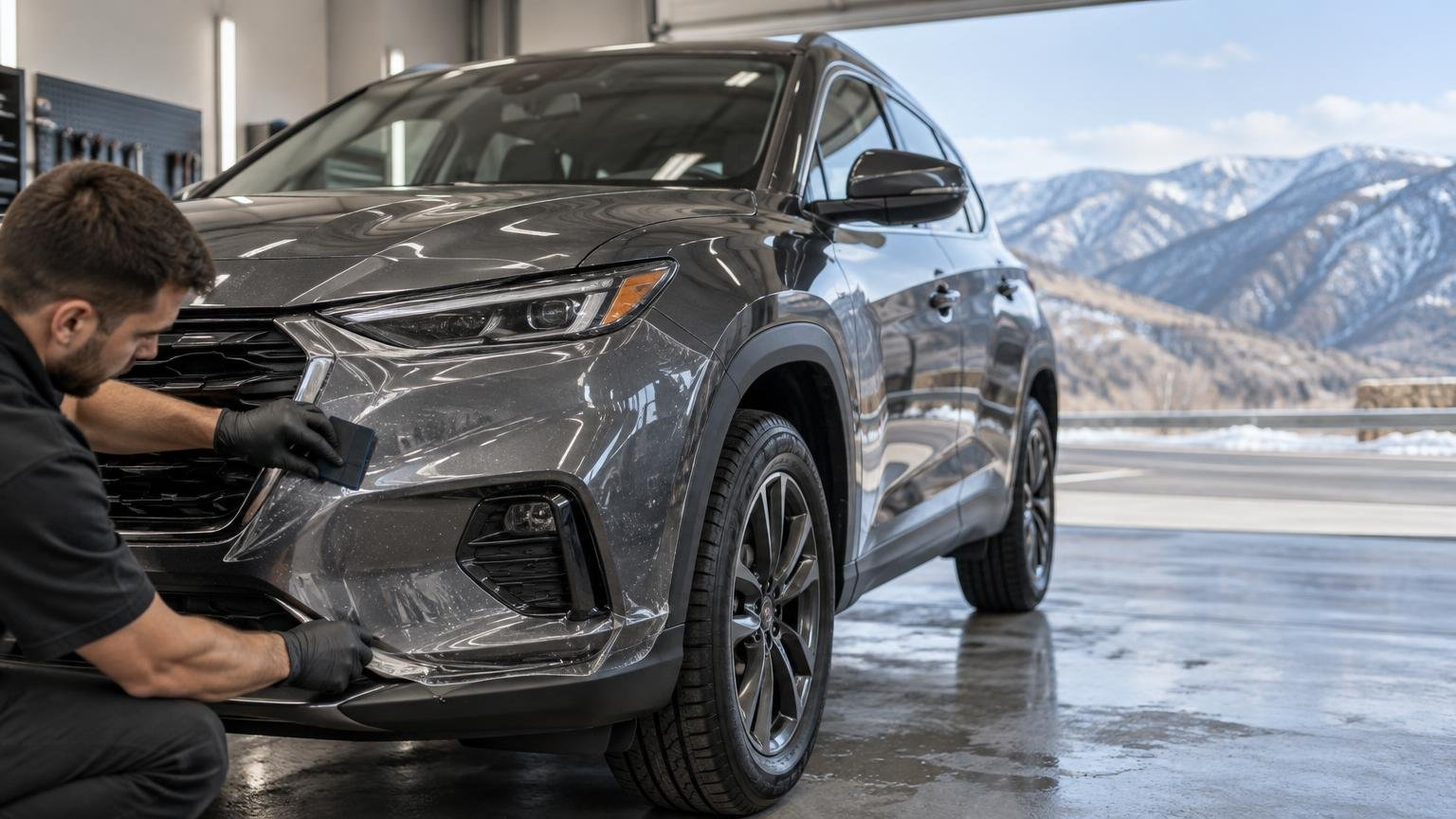
Paint protection film is a physical layer installed over painted surfaces. Its main job is to help reduce damage from road debris, gravel, bug residue, light scratches, and similar exposure. It is commonly applied to the front bumper, hood, front fenders, mirror caps, rocker panels, lower doors, and areas ahead of or behind the wheels. The useful coverage map changes with vehicle shape, tire width, mileage, and road use.
Ceramic coating is a liquid-applied surface treatment. Product characteristics vary, but hydrophobic behavior is a central feature of many coatings. XPEL, for example, describes its FUSION PLUS Paint & PPF product as a hydrophobic coating intended for painted surfaces and PPF. XPEL’s paint-protection guidance also states that this specified coating can be used on XPEL film without voiding the film warranty.
That distinction matters. A coating may improve water behavior and support appearance maintenance, but it does not become a flexible impact-absorbing film. PPF can reduce chip and abrasion risk on covered panels, but it does not make paint indestructible or eliminate washing. Even films with self-healing topcoats address surface-level marks rather than guaranteeing recovery from deep scratches or hard impacts.
| Your main concern | Best starting point | Why |
|---|---|---|
| Rock chips and freeway debris | PPF on exposed panels | Film provides a physical sacrificial layer where debris strikes. |
| Water behavior and routine appearance care | Ceramic coating | A coating adds hydrophobic surface properties but limited impact protection. |
| Both impact exposure and easier surface care | PPF plus a compatible coating | Film handles the higher-impact zones while coating changes surface behavior. |
| Low mileage, older paint, or willingness to accept wear | Possibly neither | Protection may not justify the cost if cosmetic preservation is a low priority. |
Why Utah use can shift the decision toward PPF
Utah driving can combine freeway mileage, construction debris, canyon travel, gravel approaches, and winter contamination. A coating can be useful when frequent washing and winter grime are the main frustrations, but it cannot substitute for film on a bumper or hood that regularly encounters road debris.
Winter adds another maintenance reason to think carefully about the combination. The Utah Department of Transportation’s snow-removal information says crews use salt brine, white salt, high-performance salts, de-slicking grit, volcanic cinders, and potassium acetate in certain locations. These materials can contribute to residue and grit on vehicle exteriors. PPF, coating, both, or bare paint still need routine cleaning during winter.
For a Utah daily driver with substantial I-15 mileage, I would start by evaluating the front bumper, full hood, front fenders, and mirrors for film. Rocker panels, lower doors, and wheel-impact areas deserve a second look on trucks, SUVs, wide-tire performance cars, and vehicles that regularly visit trailheads or gravel roads. That is a coverage decision, not an argument that every vehicle needs full-body film. The broader Utah winter PPF coverage guide explains how to prioritize those panels.
When PPF alone makes sense
Choose PPF first when physical paint damage is the main concern and the budget needs to stay focused on the panels most likely to be hit. A high-mileage commuter, canyon driver, or new-vehicle owner who wants to preserve the front end may receive more practical value from a well-defined film package than from coating the entire vehicle while leaving the impact zones uncovered.
The specific film matters. Some current PPF products already advertise water-beading or ceramic-like surface properties. LLumar describes Valor as combining self-healing film protection with a ceramic-like finish, while SunTek markets Reaction as combining film and coating-related benefits. That does not make every PPF equivalent to a separately applied coating. It means buyers should compare named products instead of assuming all films have identical topcoats and surface behavior.
Ask what panels are included, where seams will appear, which edges can be wrapped, and whether headlights or other small areas are part of the package. If two quotes use different coverage maps, they are not the same job yet. The Utah PPF package guide can help translate package labels into actual covered panels.
When ceramic coating alone makes sense
Coating alone can be a reasonable choice for a vehicle with limited debris exposure when the owner's priority is hydrophobic surface behavior and appearance care. Examples may include a lower-mileage vehicle that spends little time on freeways, a leased vehicle whose owner does not want film, or a car whose owner accepts that the paint may collect chips over time.
The tradeoff should be explicit: ceramic coating is not a substitute for PPF where rock impacts are the concern. SunTek directly distinguishes ceramic coatings from its film by stating that coatings do not provide the same level of rock-chip and surface protection. A coating-only buyer should be comfortable accepting impact damage that a film-covered panel might have reduced.
Coating also does not create a maintenance-free car. Manufacturer care instructions still call for washing and prompt removal of contaminants, with methods and restrictions varying by product. Before buying, ask which shampoo, wash method, decontamination products, and inspection schedule the coating manufacturer specifies.
When using both is worth considering
PPF plus ceramic coating makes the strongest case on a newer vehicle that sees regular debris exposure and whose owner also values easier routine appearance care. The common strategy is to install PPF on the selected impact zones, then apply a compatible coating over the film and remaining painted surfaces. This creates more consistent surface behavior without pretending the coating adds meaningful rock-chip protection to uncovered paint.
Compatibility is the important word. A coating should not be applied before film unless the film manufacturer and installer explicitly approve the process. LLumar says waxes and other coatings applied before PPF can interfere with film adhesion. LLumar’s PPF guidance also explains that product care and installation requirements vary, which is why a generic promise that “any coating works over any film” is not enough.
A same-manufacturer pairing may simplify the answer, but the warranty terms still deserve attention. XPEL states that its FUSION PLUS Paint & PPF coating may be used on XPEL PPF without voiding the film warranty. Its coating warranty also includes product-specific requirements, including annual visits to the certified installer that applied it. Other brands and product combinations may use different terms.
Questions to ask about coating over PPF
- What are the exact film and coating product names?
- Does the film manufacturer approve this coating over that specific film?
- Will the coating change the appearance of gloss, matte, or satin film?
- How long must the film cure before the coating is applied?
- Which warranty covers the film, and which warranty covers the coating?
- Are inspections or annual maintenance visits required to keep either warranty active?
- What wash products and decontamination methods are approved for the finished combination?
- If one film panel is replaced later, what will recoating that panel involve?
Existing paint condition can change the answer
Film and coating preserve the surface they are installed over; they do not erase existing damage. Chips and scratches may remain visible beneath PPF. Repainted panels also need additional attention because film warranty coverage and removal risk can differ from factory paint. LLumar says its PPF is designed for original painted surfaces, identifies limits involving aftermarket or repaired paint, and notes that newly painted surfaces commonly need 30 days to outgas before installation.
That makes a paint inspection important before either purchase. Ask the installer to identify repainted panels, active chips, scratches, oxidation, and contamination that may require correction. If the vehicle already has a coating, disclose it before scheduling PPF because the installer may need to prepare the surface differently.
Neither option eliminates regular care
Protected vehicles still need sensible washing. Film edges, seams, and corners deserve particular care because a concentrated pressure stream can contribute to lifting. LLumar discourages pressure washing and automatic washes for this reason, while UtahPPF similarly advises against directing concentrated water at exposed film edges. Matte and satin films also need non-abrasive products because abrasion can create uneven shiny areas.
Follow the instructions for the installed products rather than relying on a universal waiting period or wash routine. XPEL’s care documentation, for example, lists different post-installation waiting periods for different film products. Record the film and coating names when the job is completed so future detailers know what they are maintaining.
A practical recommendation for Utah drivers
Start with the damage you want to prevent. If rock chips and road debris are the problem, prioritize PPF on the panels that receive those impacts. If water behavior and appearance maintenance are the priority, compare ceramic coatings. If both concerns matter and the vehicle will be kept for years, price a compatible film-and-coating system—but compare it against putting more of the budget into useful film coverage first.
Request itemized quotes that name the covered panels, film product, coating product, preparation, edge treatment, warranty conditions, and total price. Then compare the same scope. For many Utah commuters, targeted or full-front film is the logical first purchase; coating becomes the optional second layer when its maintenance and surface benefits justify the added cost.
References
- Answers to your Paint Protection Film Questions | SunTek
- Frequently Asked Questions (FAQs) – XPEL Support
- www.xpel.com
- How to Care for Paint Protection Film in Utah – Utah PPF
- Snow Removal | UDOT
- Paint Protection Film Frequently Asked Questions | LLumar
- XPEL Product Care Instructions – XPEL Help Center
- Paint Protection Film Utah – Utah PPF