TLDR
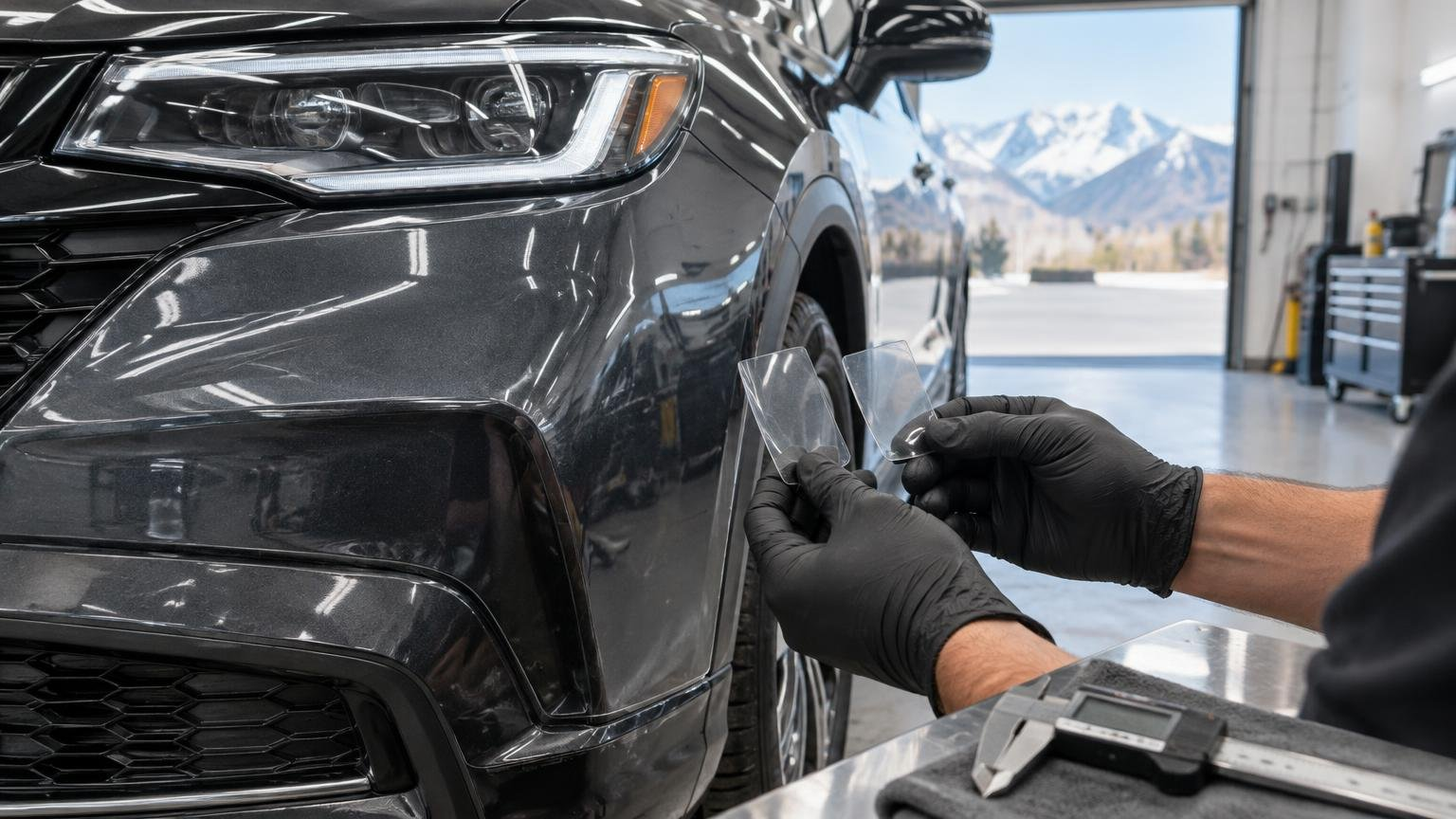
Thicker paint protection film is not automatically the better buy. Thickness can be meaningful when two products use the same measurement basis, but it does not independently establish clarity, finish, topcoat behavior, durability or suitability for a particular vehicle. Start by asking whether the stated thickness includes the adhesive and whether it excludes disposable handling layers. Then compare the film’s construction, finish, supported application, warranty and actual panel coverage.
What a PPF thickness number actually means
PPF thickness is commonly stated in mils, micrometers or millimeters. One mil is one-thousandth of an inch, equal to 0.0254 millimeter. That makes 8 mil approximately 0.203 millimeter. A mil is not a millimeter, despite the similar names. Confusing the two would turn an ordinary PPF specification into a number almost 40 times larger than intended.
The number becomes useful only after you identify what was measured. A product sheet might report the polyurethane layer alone, the installed film plus adhesive, or another combination. Cap sheets and release liners are used for handling and installation but are removed rather than left as part of the protective stack.
For example, the 3M Pro Series 200 Gloss technical data sheet lists film with adhesive at 7.8 mil, or 0.20 millimeter. It separately identifies a 1.0-mil cap sheet and a 3.0-mil liner. Adding those removable layers to the installed-film figure would produce a misleading comparison.
How current product specifications compare
The following examples show why the measurement basis and layer construction belong beside the headline number. They are technical-sheet comparisons, not controlled impact-test rankings.
| Product | Published thickness | Measurement basis | Construction or finish detail |
|---|---|---|---|
| 3M Pro Series 200 Gloss | 7.8 mil (0.20 mm) | Film with adhesive; cap sheet and liner listed separately | Gloss film with hydrophobic features and heat-assisted self-healing |
| XPEL ULTIMATE PLUS | 7.60 mil (193 µm), ±10% | Total without release liner | 0.50-mil clearcoat, 6.0-mil polyurethane and 1.1-mil adhesive |
| XPEL ULTIMATE FUSION | 7.48 mil (190 µm), ±10% | Total without release liner | 0.38-mil hydrophobic clearcoat, 6.0-mil polyurethane and 1.1-mil adhesive |
| XPEL ULTIMATE PLUS 10 | 9.60 mil (244 µm), ±10% | Total without release liner | 0.50-mil clearcoat, 8.0-mil polyurethane and 1.1-mil adhesive |
| XPEL STEALTH | 8.15 mil (207.01 µm), ±10% | Total without release liner | 0.65-mil hydrophilic topcoat, 6.0-mil polyurethane, 1.5-mil adhesive and satin finish |
These figures come from the manufacturers’ published product sheets. Within XPEL’s stated measurement convention, ULTIMATE PLUS 10 has an 8.0-mil polyurethane layer compared with the 6.0-mil layer listed for ULTIMATE PLUS. That is a legitimate thickness distinction. It still does not prove that the thicker product is the best choice for every panel, finish, budget or driving pattern.
STEK illustrates another reason to request the underlying data sheet. Its DYNOshield product page states 8 mil, while linked technical data identifies the urethane-film layer as 150 ±3 micrometers. The available documents do not establish that those figures use the same measurement basis, so they should not be treated as contradictory or directly interchangeable without clarification.
Why thicker does not settle the buying decision
Topcoat and surface behavior
The topcoat affects characteristics such as gloss, satin appearance, water behavior and recovery from minor surface marks. XPEL lists ULTIMATE PLUS above 90 gloss units, while satin-finish STEALTH is listed at 23 gloss units. STEALTH is slightly thicker overall, but the more important buying distinction is that it is intended to produce a different appearance.
Self-healing language also needs context. It generally concerns minor swirls and light surface scratches, not deep cuts or heavy impacts. The site’s PPF and self-healing explanation covers that feature separately. A thicker gauge should not be interpreted as proof that all damage will disappear.
Clarity, finish and fit
A film can have an impressive thickness number and still be wrong for the requested finish or application. Buyers should confirm whether the product is clear gloss, satin or another finish; whether the manufacturer supports its use on the vehicle’s paint type; and whether the installer intends to use it on the requested panels. 3M identifies Pro Series 200 Gloss for OEM painted surfaces, while STEK positions DYNOshield for factory gloss paint.
Fit is also part of the result. Ask about the coverage pattern, seams and edge treatment instead of expecting the gauge to compensate for an incomplete coverage map. A carefully chosen film cannot protect a rocker panel, lower door or rear-wheel impact area that was never included in the quote.
Warranty terms
A ten-year headline is not a complete warranty comparison. 3M directs buyers to the warranty card or an authorized installer for full consumer terms, while STEK states a ten-year warranty against specified defects. Request the written manufacturer terms, covered defects, exclusions and claim process. Installer workmanship coverage should be identified separately.
Thickness and coverage solve different problems
For a Utah driver, the question is less about finding the largest number and more about identifying which panels take the hits. Freeway commuting, construction debris and canyon travel tend to put the front bumper, hood, fenders and mirrors high on the list. Gravel approaches, mountain trips and wider tires can make rockers, lower doors and areas near the wheels more important.
That is why partial-front, full-front, high-impact and full-body packages should be compared by their covered panels, not by package names alone. A 9.6-mil film on a small partial-front area and a 7.6-mil film across a full front are fundamentally different purchases. The better choice depends on where exposure occurs, what finish the owner wants and how the total quote fits the budget.
Published technical testing can provide useful context, but methods and conditions matter. The reviewed XPEL sheets list categories such as mechanical properties, weathering, adhesion, chemical resistance and SAE J400 gravelometer testing. They do not provide controlled head-to-head results proving superiority over competing films.
Specifications to request on a PPF quote
If two quotes use different films or coverage maps, they are not the same job yet. Use the site’s PPF quote-comparison guide to normalize the broader project, then request these film details:
- Exact manufacturer and product series, not merely a brand name
- Published total thickness and whether it includes the adhesive
- Separate polyurethane, topcoat and adhesive thicknesses when available
- Confirmation that the release liner and cap sheet are excluded from the installed thickness
- Clear gloss, satin, matte or color finish
- Supported paint surfaces and intended vehicle applications
- Topcoat features, with self-healing and hydrophobic claims treated as separate characteristics
- Exact panels, seams and edge treatment included in the quote
- Written manufacturer warranty terms and separate installer workmanship coverage
Thickness deserves a place on the comparison sheet, especially when evaluating related products measured the same way. It should not occupy the whole sheet. For most buyers, the sensible purchase is the film construction and coverage map that match the vehicle’s finish, exposed panels and real Utah driving—not simply the biggest mil number.
References
- Scotchgard PPF Pro Series 200 Gloss TDS RB.pdf
- assets.contentstack.io
- assets.contentstack.io
- assets.contentstack.io
- assets.contentstack.io
- DYNOshield Hydrophobic Paint Protection Film | STEK USA
- Paint Protection Film Utah: What To Know Before You Protect Your Car – Utah PPF
- PPF Packages Utah – Utah PPF
- How Much Does PPF Cost In Utah? – Utah PPF