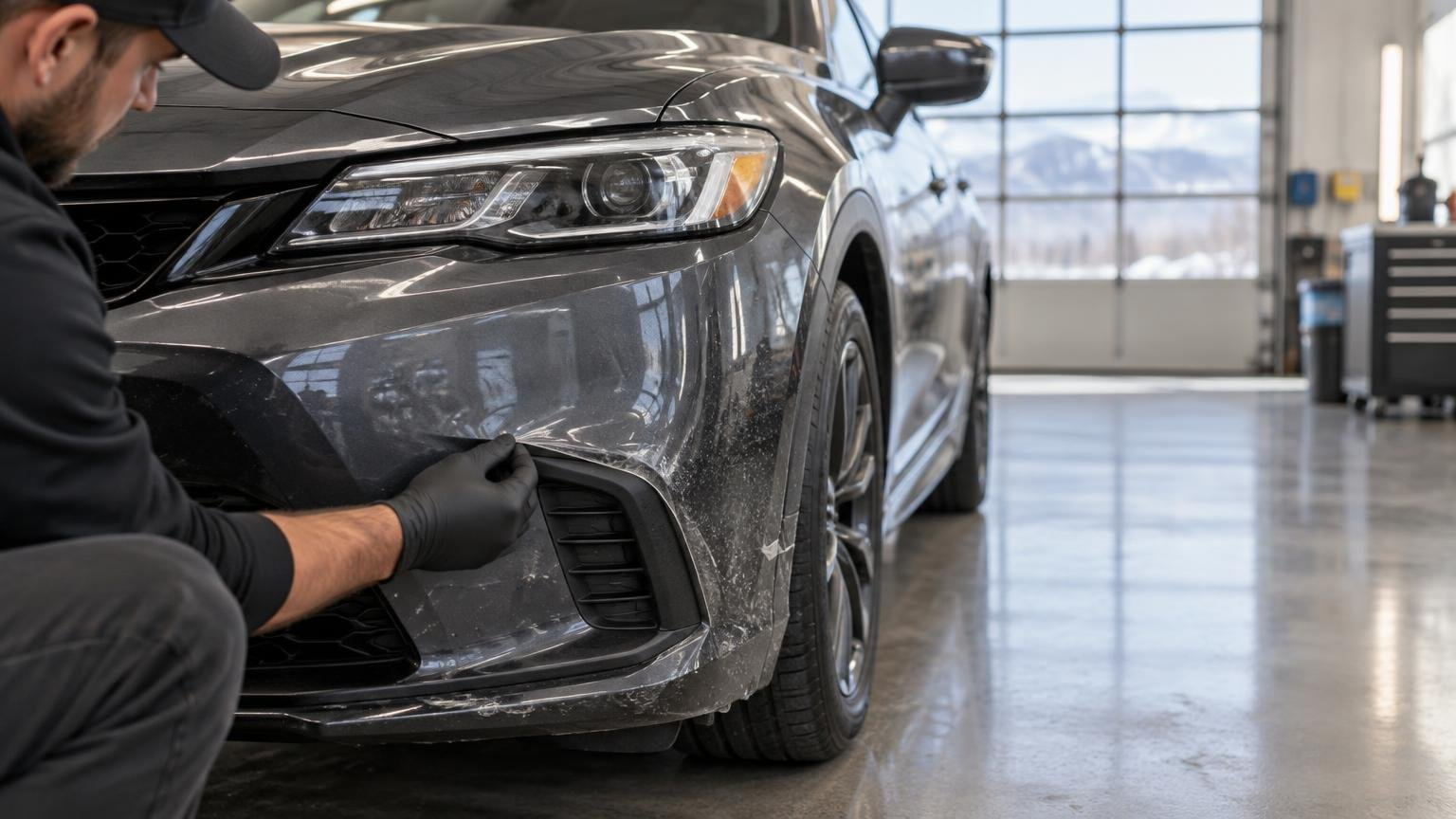
Aging paint protection film needs inspection when you notice cracking, lifting, peeling, bubbling, persistent discoloration, or a meaningful decline in its appearance. Those symptoms justify an assessment, but they do not establish from a distance that the film must be removed. Depending on the condition and how much film is affected, the sensible next step may be maintenance, monitoring, replacement of film on one or more panels, or professional removal.
There is no universal replacement age for PPF. Current manufacturer materials show different warranty periods across products and product lines, including five-, seven-, and 10-year terms. Those periods describe limited warranty coverage; they are not automatic removal dates or guarantees that every installation will have the same useful life.
For a Utah owner, the practical question is less about how many winters appear on the calendar and more about what the film looks like now, where the change is occurring, and whether its installation history can be identified.
Start with condition, not a birthday
Film age belongs in the assessment, but it should not make the decision by itself. PPF installed on a garage-kept weekend car may have a different history from film on a high-mileage I-15 commuter, a truck driven to gravel trailheads, or an SUV that spends each winter carrying ski gear through road grime.
Product line, installation quality, care, vehicle storage, impact damage, contamination, and prior body work can all affect what an owner sees. Even two panels on the same vehicle may age differently because the front bumper takes direct impacts while a door or roof sees a different mix of exposure.
Use the approximate installation date as one data point. If the film still appears uniform, remains secure at its edges, and has no developing damage, age alone does not prove that removal is due. If its history is unknown or visible changes have begun, arrange an inspection rather than selecting an arbitrary replacement interval.
Changes that justify a closer inspection
Visible cracking
Cracks in the film are a clear reason to request an assessment. Record whether they appear in one impact area, along an edge, across a single panel, or on several panels. Manufacturer product and warranty materials specifically address cracking among the conditions relevant to film performance, although coverage still depends on the product, cause, exclusions, and documentation.
Avoid assuming that one cracked area requires the entire vehicle to be stripped. An installer needs to determine whether the issue is confined to one piece of film or reflects a broader change across the installation.
Lifting, peeling, or changing edges
Inspect seams, corners, panel boundaries, wheel-opening areas, and wrapped edges. Look for sections that have lifted, begun to peel, or changed noticeably since the previous wash. The current 3M installation and care guidance advises inspecting PPF for lifting or peeling, particularly after washing, and notes that loose film can tear away from a moving vehicle.
A small edge change still deserves attention before it spreads or traps more grime. Do not cut, pull, or glue the edge as an improvised repair. Photograph it and ask whether it needs cleaning, professional attention, replacement of that section, or another remedy.
Bubbles or new separation beneath the film
Bubbling is another condition addressed in current manufacturer warranty materials. Note its location, approximate size, and whether it is stable or spreading. Photos taken over several days can help distinguish a persistent change from something noticed only once.
The appropriate remedy depends on the affected film and the underlying condition. A photo may help an installer triage the concern, but it cannot establish the cause or confirm warranty coverage.
Persistent discoloration or cloudiness
A panel that looks yellowed, cloudy, stained, or otherwise different from adjacent panels should be documented and assessed. Manufacturer warranty terms distinguish covered film defects from excluded conditions and other possible causes, which may include ordinary wear, contamination, water-spot staining, improper washing, or physical damage depending on the product.
Use consistent lighting when taking photos, and include both the affected panel and a nearby comparison panel. Keep symptom-specific cleaning experiments separate from the removal decision. Aggressive polishing or abrasive products can make the surface harder to evaluate and may permanently reduce film quality; follow the identified product's care instructions instead. For routine ownership practices, review this guide to caring for paint protection film in Utah.
Loss of gloss or unacceptable appearance
Film can become a removal candidate even when it has not visibly split or peeled. If its surface no longer looks acceptable to the owner, document whether the change is uniform, limited to high-impact panels, or associated with a particular event.
Product identification matters here. XPEL, for example, publishes product-specific warranty terms rather than one universal promise for every film; its ULTIMATE FUSION terms separately address loss of gloss, oxidation, ultraviolet damage, and fading for four years. That illustrates why an invoice and exact product name are more useful than relying on the general statement that the car “has PPF.”
Build a useful record before requesting an assessment
A concise record helps an installer understand the scope and determine which warranty or service questions apply. It also gives you a baseline if the change is gradual.
- Record the vehicle year, make, model, color, and affected panel.
- Estimate the installation date or note when you acquired the vehicle.
- Find the film brand and exact product line if available.
- Gather the installer name, invoice, warranty registration, and prior correspondence.
- Take wide and close photos in consistent natural light.
- Note whether the condition is isolated, stable, or spreading.
- List relevant collision, body, paint, or previous film work.
- Record recent events such as an impact, pressure washing, detailing, or harsh contamination.
Missing records do not mean that the film has failed, but they can make product identification and a warranty claim more difficult. 3M directs owners to begin with the installer when possible, while XPEL’s warranty information states that proof of installation from an authorized installer is required for a claim.
If the original installer is unknown, start with a local PPF professional and explain that the product and installation date are uncertain. Ask what can be learned from an in-person inspection and what must remain unknown without the records.
Choose among maintenance, monitoring, replacement, and removal
The assessment should lead to a defined next step rather than a vague opinion that the film is “old.” Ask the installer to identify the affected panels, describe the observed condition, and explain the available options.
| Possible next step | When to discuss it | What to confirm |
|---|---|---|
| Product-appropriate maintenance | The film remains secure and the concern may involve surface condition or care | The identified film, approved products, and realistic appearance improvement |
| Monitor and document | The change is minor, stable, and not creating a loose-film concern | What to photograph, how often to check it, and what change should trigger service |
| Localized replacement | The condition appears confined to one panel or piece of film | Whether adjacent film will differ in age or appearance and whether the scope can remain localized |
| Broader replacement or removal | Changes affect several panels, appearance is unacceptable, or the installation needs a wider reset | Exact panels, removal method, underlying paint considerations, and replacement priorities |
Localized replacement can be practical when damage is limited, but it is not guaranteed to suit every visible issue. Current 3M guidance says repair, removal, or replacement may be appropriate for damaged PPF, leaving the correct option dependent on the condition and scope.
If replacement is recommended, decide whether you still need the same coverage map. A Utah freeway commuter may continue to prioritize a full front. A truck that now sees more gravel access may need discussion of rocker panels and rear-wheel impact areas. A vehicle driven less often may justify a smaller replacement scope. The new quote should name every covered panel rather than merely reuse a package label.
Treat removal as professional work
Do not test aging film by pulling a loose corner. Manufacturer guidance treats removal as a controlled service process. 3M recommends specific use of heat or steam, a defined pull angle, and hiring a PPF installation professional. XPEL’s product-care guidance also says PPF removal should be performed with a steamer.
Before authorizing removal, tell the installer about any known repainting, collision repair, touch-up work, or previous film replacement. The condition and history of the surface beneath the film can affect how the project should be evaluated. If the paint history is uncertain, say so rather than guessing.
Ask for the removal scope in writing. Confirm whether the quote covers one panel, a complete coverage package, adhesive cleanup, inspection after removal, and installation of new film. If replacement film is proposed, compare the new scope by exact panels, named product, finish, edge treatment, preparation, and warranty terms. The condition of exposed paint should determine whether any correction is discussed; it should not be assumed automatically. The guide to paint correction before PPF explains how to separate necessary preparation from optional finish improvement.
Warranty questions to ask without assuming coverage
A symptom can resemble something listed in warranty materials without qualifying for coverage. The cited 3M warranty includes exclusions such as ordinary wear, misuse, accidents, misapplication, rock-debris dents, and paint pull during removal. XPEL lists exclusions including collision or physical damage, improper washing, scratches or chips in painted surfaces, and water-spot staining.
Ask the installer or manufacturer these specific questions:
- Which film and product line are installed?
- Was the product registered, and is proof of installation available?
- What warranty term applied to that product at the time of installation?
- Does the observed condition require an in-person inspection or claim submission?
- What photos, invoices, or installer records are required?
- If coverage does not apply, what are the paid maintenance, replacement, and removal options?
Keep the warranty term and service-life decision separate. A film can merit inspection before its warranty ends, and reaching the end of a warranty does not automatically mean secure, acceptable-looking film must be removed.
A practical decision rule for aging PPF
Request an assessment when the film develops cracking, persistent discoloration, bubbling, lifting, peeling, spreading edge changes, or an appearance decline that matters to you. Also request one when the film's age and identity are uncertain enough that you cannot evaluate its warranty or care requirements.