The practical difference between colored PPF and vinyl wrap starts with the goal. Choose a specific color paint protection film when protecting the covered paint from road exposure matters as much as changing the vehicle’s appearance. Choose vinyl when the main objective is a particular color, texture, graphic, or specialty finish. Vinyl can cover paint and change its look, but it should not automatically be treated as equivalent to PPF for rock and debris exposure.
For a Utah daily driver, that distinction matters. Freeway debris, construction zones, canyon trips, loose gravel, winter grime, and mountain access roads can make the front end and lower impact zones a bigger priority than the roof or upper doors. The right answer may be full-body color PPF, a full vinyl wrap, or a mixed project using vinyl for appearance and compatible PPF over selected impact areas.
The short comparison
| Decision factor | Colored PPF | Vinyl wrap |
|---|---|---|
| Primary purpose | Color change plus the protection characteristics documented for the selected PPF product | Color, finish, graphics, or styling |
| Appearance range | Depends on the manufacturer’s available colors and finishes | Often the better starting point for specialty effects, textures, printed graphics, and a wide finish selection |
| Impact claims | Must be verified for the named product line | Do not assume PPF-equivalent impact protection unless the manufacturer documents it |
| Project scope | Can cover selected impact zones or most painted exterior panels | Commonly applied as accents, partial decoration, or a full exterior color change |
| Quote comparison | Compare exact panels, film, preparation, edges, seams, warranty, and removal terms | Compare the same factors, plus jambs, hidden areas, directional film requirements, and graphics work |
| Best fit | Drivers whose protection goal justifies the available color and project cost | Drivers whose desired appearance matters more than impact protection |
This is a purpose-based comparison, not a claim that every colored PPF outperforms every vinyl. Film construction, thickness, topcoat, test results, finish, and warranty vary by product line. Ask for the manufacturer and exact product name before accepting a general statement about either category.
Protection depends on the named film, not the category label
“Colored PPF” describes a product category, but the useful evidence comes from the specific film. For example, the XPEL COLOR PPF gloss technical data sheet lists a nominal thickness of 7.71 mil and a construction that includes color-infused polyurethane, clear polyurethane, acrylic adhesive, and a hydrophilic topcoat. It also describes light-scratch self-healing and reports that this product passed XPEL’s SAE J400 gravelometer test. Those details apply to that named XPEL film; they are not universal specifications for all colored PPF.
Vinyl color-change film is built around a different job. The 3M Wrap Film Series 2080 product bulletin describes 2080 as a multilayer cast, adhesive-backed vinyl for full wraps, accents, and partial decoration. Its Controltac and Comply features support repositioning and air release during installation. They are installation features, not impact-protection claims.
If protection leads your decision, start with the panels that take the hits and then see whether the available PPF colors satisfy your appearance goal. The broader Utah paint protection film overview can help establish that protection-first scope before you compare color options.
Vinyl usually gives the appearance-first buyer more directions to explore
Vinyl is the natural starting point when the desired result involves gloss, satin, matte, metallic, color-shift, brushed-metal, textured, printed, or other specialty effects. Colored PPF can offer striking gloss and satin choices, but availability depends on the selected manufacturer and product line.
Even familiar finish words need context. Gloss reads more like conventional paint, satin sits between gloss and matte, and matte produces a flatter, less reflective surface. In XPEL’s cited documentation, its COLOR PPF gloss film reports 95 gloss units at 60 degrees, while the satin film reports 19 gloss units. Those figures describe the named XPEL products rather than every gloss or satin film.
Some vinyl finishes also require installation planning that may not be obvious from a small sample. 3M states that certain metallic, pearl, textured, and color-flip 2080 films can be directional. It calls for consistent film orientation across panels and recommends using the same lot number for a full vehicle to reduce visible color variation.
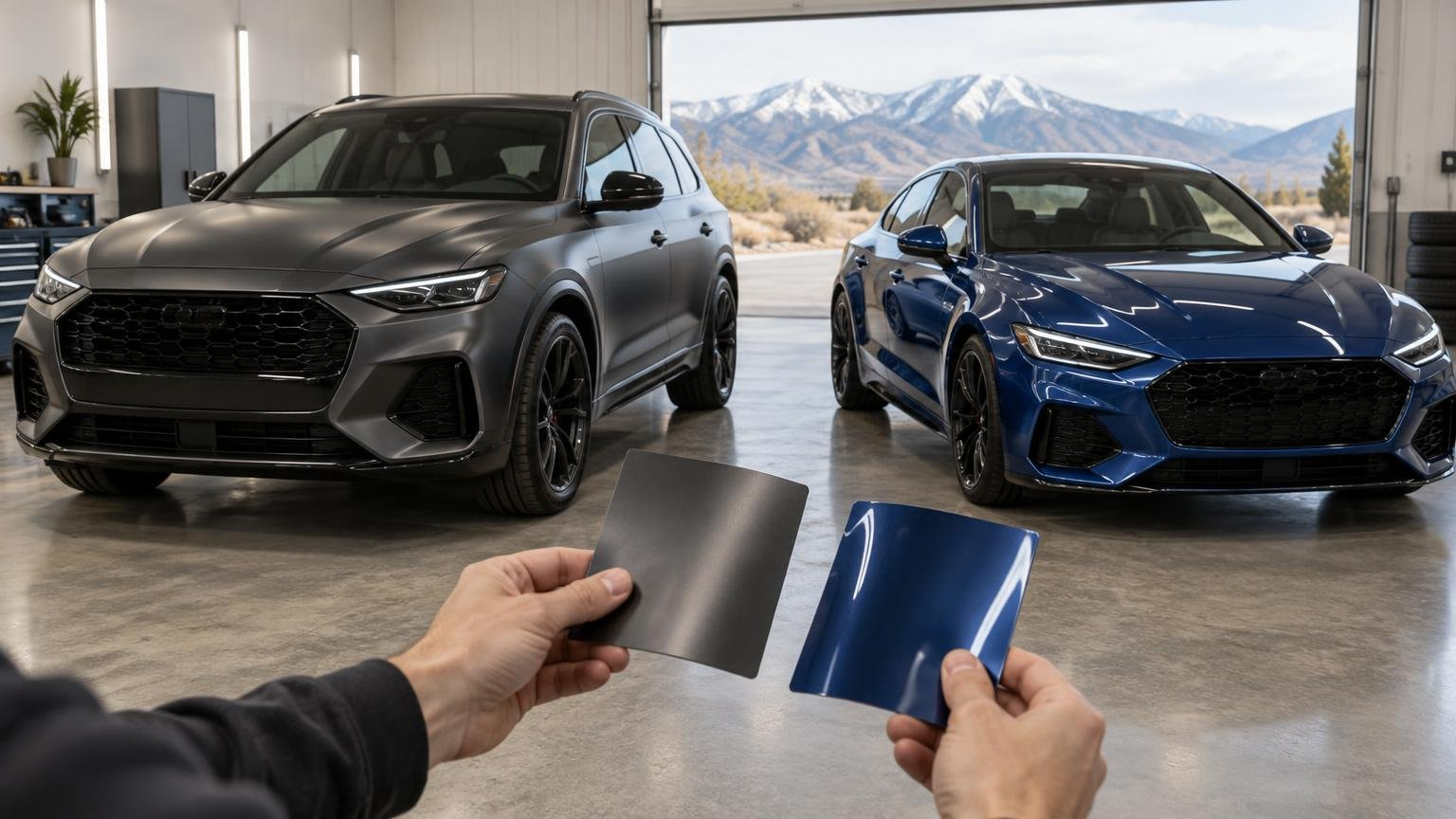
A physical sample viewed outdoors is more useful than choosing from a screen alone. Look at it in direct sun, shade, and artificial light, then compare it beside the vehicle’s trim and wheels. Buyers focused primarily on styling can also review vinyl car wrap appearance options and UtahPPF’s vinyl wrap guidance.
Choose the coverage map before comparing prices
A full vinyl wrap and a front-only colored PPF quote are not competing versions of the same project. One changes the visible exterior across the vehicle; the other may concentrate spending on the surfaces that face road debris. Normalize the covered panels first.
A typical full-front PPF scope commonly includes the full bumper, hood, front fenders, and mirrors, with headlights sometimes included. Rockers, lower doors, and rear-wheel impact areas are common additions for trucks, SUVs, low vehicles, and drivers using gravel, canyon, or mountain roads.
Partial-front PPF usually stops partway across the hood or fenders, which can leave a visible line. Full-front coverage extends across the complete hood and fender panels. Full-body PPF generally adds doors, rockers, quarter panels, the rear bumper, and the trunk or hatch to front-end coverage, but shops may define “full body” differently.
Use the PPF package and coverage guide to create a panel list, then ask each installer to quote that same list. For regular gravel or trailhead access, the Utah gravel-road coverage guide explains why lower-body and rear-wheel areas may deserve attention beyond the front bumper.
Ask whether the quote includes jambs and hidden areas
A standard exterior color-change wrap can leave original paint visible when the doors, hood, or hatch are opened. Adding door jambs and other hidden areas increases labor, material use, installation complexity, and project time.
That does not make exterior-only coverage incomplete; it means the quote reflects a particular finish standard. Decide whether you care about visible original paint in openings before comparing totals. The same rule applies to disassembly around trim, badges, handles, lights, and bumpers: two finished vehicles can look similar from ten feet away while involving very different amounts of labor.
Compare total quoted cost, not a universal price range
There is no useful universal price winner. Vehicle size and shape, film choice, panel count, paint condition, preparation, pattern availability, disassembly, seams, edge treatment, jamb coverage, add-ons, and installation complexity can all change the quote. UtahPPF’s reviewed pages therefore treat pricing as custom rather than publishing a fixed package price.
Request itemized written quotes with the following fields matched as closely as possible:
- Exact film manufacturer, product line, color, and finish
- Every covered and excluded panel
- Exterior-only coverage or included jambs and hidden areas
- Headlights, mirrors, rockers, lower doors, rear-wheel impact zones, door cups, door edges, and bumper loading areas
- Cleaning, decontamination, paint correction, and other preparation
- Disassembly and reinstallation of badges, trim, lights, handles, or bumpers
- Use of seams, precut patterns, bulk installation, and wrapped edges where relevant
- Warranty issuer, duration, exclusions, transferability, and responsibility for labor
- Removal scope, removal pricing if offered, and paint-condition limitations
- Total project price and any separately priced options
If two quotes use different coverage maps, they are not the same job yet. A lower quote may simply exclude jambs, preparation, disassembly, lower impact areas, or labor associated with more complete edge treatment.
Care requirements belong in the purchase decision
Both products need suitable washing practices, but the exact instructions come from the film manufacturer. XPEL’s COLOR PPF care guidance says to wait 72 hours after installation before washing. It recommends washing after the vehicle has cooled, promptly removing contaminants, avoiding automatic tunnel washes and unapproved solvents or abrasives, and maintaining a three-foot distance when pressure washing. Review XPEL’s current product-care instructions for the selected film.
For 3M Wrap Film Series 2080, 3M recommends hand washing or a brushless wash without hot wax, using mild detergent without wax additives, and drying the film thoroughly. 3M’s current 2080 product information should be checked for the applicable care and warranty documents.
These instructions affect ownership. If your normal routine depends on automatic tunnel washes, discuss that before selecting the product. A finish that requires care you will not realistically provide is a poor match, regardless of how good it looks on installation day.
Removal risk starts with the paint underneath
Film removal is not just a question of whether the top material is vinyl or polyurethane. Stable factory-quality paint generally gives the installer a more predictable starting point than peeling, weak, or previously repaired paint. Existing bodywork, failing clear coat, and unknown repaint history should be identified before installation.
XPEL recommends professional removal of its PPF and publishes a method involving steam and a shallow pull angle to reduce adhesive left on the paint. 3M says 2080 can be removed from most surfaces with heat and/or chemicals within the applicable warranty period. Neither statement guarantees a problem-free result on compromised paint.
Ask the installer to document visible paint defects before starting. If the vehicle has repaired panels, request a specific discussion of installation and removal risk for those panels rather than relying on a general promise that film is removable.
Read warranties as product-specific defect coverage
XPEL’s current limited warranty for COLOR PPF states a 10-year period from initial installation for specified manufacturing defects, including yellowing, cracking, blistering, and delaminating, when professionally installed as recommended. It does not function as insurance against paint damage, and exclusions include stains, scratches, improper washing, automatic car washes, and damage not caused by a manufacturing defect. Read the current XPEL warranty terms for the exact coverage and claim requirements.
3M states that its vehicle-owner warranty for Wrap Film Series 2080 covers qualifying material and manufacturing defects such as yellowing, bubbling, and cracking. Its published maximum duration is up to eight years for vertical exposure and up to three years for horizontal exposure, depending on warranty zone and exposure angle. Ordinary wear and dents caused by rocks or road debris are among the exclusions.
Those published periods should not be turned into a blanket claim that one film category lasts a certain number of years longer than the other. They cover different products, defect types, orientations, conditions, zones, and exclusions. Compare the warranty document for the exact film in your quote, then ask who handles inspection, removal, replacement film, and installation labor if a claim is approved.
When a combined vinyl and PPF project makes sense
A combined project can work when vinyl provides the desired color or specialty effect while compatible clear PPF protects selected high-impact areas. This is most relevant when the appearance cannot be achieved with the available colored PPF choices but freeway, canyon, or gravel exposure still justifies added protection.
Treat the system as a planned installation rather than independently ordering two layers. Confirm compatibility, installation order, edge placement, expected appearance, warranty implications, and future removal with the installer and film manufacturers. Adding layers also adds cost and complexity, so compare that total against a single-product alternative.
A practical choice for Utah drivers
Start with colored PPF if you want a color change and your first concern is protecting the covered panels from the type of exposure addressed by the selected product’s documentation. Verify that you like an available color, then compare protection evidence, coverage, finish, care, warranty, and total installed scope.
Start with vinyl if a specific visual result is the reason for the project. It is especially relevant for specialty effects, textures, graphics, or a color that is unavailable in the PPF lines you are considering. Add PPF only where the added protection serves a clear exposure need and the films are compatible.
For a Utah commuter or mountain-use vehicle, I would first map the bumper, hood, full fenders, mirrors, rockers, lower doors, and rear-wheel impact zones. Then I would compare written quotes using the same panels and finish standard. The winning quote is the one that best matches your real priority—protection, appearance, or a deliberate balance of both—not simply the one with the lowest total.
Frequently Asked Questions
Is colored PPF more protective than vinyl wrap?
A named colored PPF may document impact-related performance that a color-change vinyl does not, but the category label alone proves nothing. Verify the construction, testing, thickness, and claims for the exact film in the quote.
Which option offers more colors and specialty finishes?
Vinyl is usually the stronger starting point for broad styling choices such as metallic, color-shift, brushed, textured, printed, matte, satin, and gloss effects. Colored PPF availability depends on the manufacturer and product line.
Can PPF be installed over a vinyl wrap?
A combined project can use vinyl for appearance and compatible clear PPF on selected impact areas. Confirm film compatibility, installation order, edges, appearance, warranty implications, and removal before approving the job.
How should I compare colored PPF and vinyl wrap prices?
Match the exact film, panels, jamb coverage, preparation, disassembly, seams, wrapped edges, add-ons, warranty responsibilities, and removal terms. If the coverage maps differ, the quotes are not for the same job.
Are door jambs normally included in a color-change quote?
Do not assume they are. A standard exterior wrap can leave original paint visible in openings, while adding jambs and hidden areas increases material, labor, complexity, and project time.
Which panels should a Utah driver prioritize for protection?
Start with the bumper, hood, front fenders, and mirrors. Rockers, lower doors, headlights, and rear-wheel impact areas may also deserve attention for gravel access, canyon travel, mountain use, or debris exposure.
Do colored PPF and vinyl wrap require the same care?
No. Follow the instructions for the selected film. XPEL’s COLOR PPF guidance includes waiting 72 hours before washing and avoiding automatic tunnel washes, while 3M recommends hand washing or a brushless wash without hot wax for Series 2080.
Does the warranty show how long each film will last?
Not by itself. XPEL COLOR PPF and 3M Series 2080 warranties cover different products, defects, exposure conditions, orientations, zones, and exclusions, so their published periods are not a universal PPF-versus-vinyl lifespan comparison.
References
- Color Change Wraps Utah – Utah PPF
- Vinyl Car Wraps – utcarwraps.com
- Paint Protection Film Utah – Utah PPF
- assets.contentstack.io
- Product Bulletin 2080 September 2024.pdf
- Full Front PPF Utah – Utah PPF
- Full Body PPF Utah – Utah PPF
- Partial Front PPF Utah – Utah PPF
- XPEL Product Care Instructions – XPEL Help Center
- 3M™ Wrap Film Series 2080 | 3M United States
- XPEL Warranty Information – XPEL Support